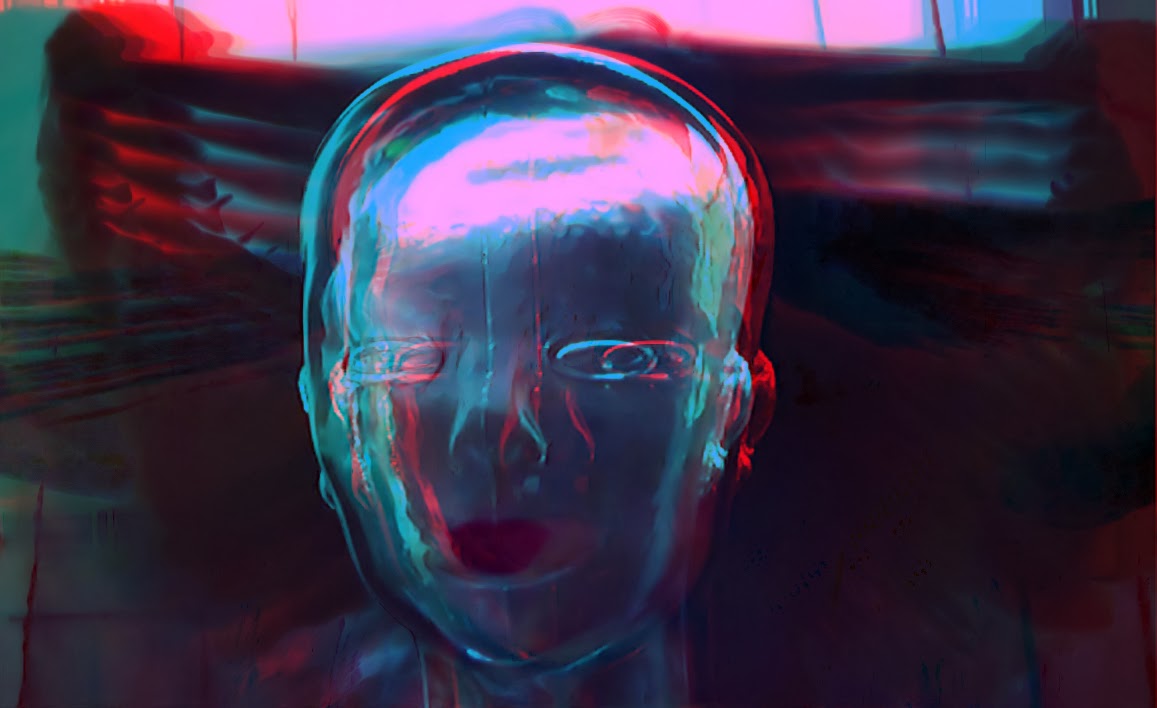
After some set back I finally got to shooting the much needed pixie scene for the 3-D Kuchar film I'm working on. I was supposed to shoot with someone else who ended up having scheduling issues.
So, instead I shot with the young and talented Brenda Contreras - filmmaker, curator and Angelino living in NYC. She was visiting the Bay Area last week and we got to talking about the project. I mentioned how I needed a performer and I wanted to keep the project in the same style as Mike Kuchar's other films - namely using non-actors to perform and often the performers are filmmakers or artists and so his films end up being an eclectic mix of cameos.
Brenda agreed and she made her way out to my place in Oakland and we spent a couple hours shooting on a green screen. She was very accommodating allowing me to spray her with sparkle spray and stand in the sun for a few hours.
The picture above is a screen shot with some very primitive and basic photoshop work to give you an idea of what it will look like in the end. It's still far from the final version.
During shooting the encouraging line was "you look just like Bjork!"
More to come soon.
Find updates on film screenings, updates on projects and random thoughts by the elusive Huckleberry Lain, poet, romantic, explorer.
Showing posts with label filmmaking. Show all posts
Monday, April 14, 2014
In Memoriam to the Cinema Palace
The following is the original, raw and unedited version of an article presented in the the 26th edition of OtherZine. You can see the edited, presentable version here: http://www.othercinema.com/otherzine/in-memoriam-to-the-cinema-palace/
The following represents a closer example of the writers voice, but it is also unpolished. It includes the accompanying video that shows footage of the demolishing of the cinema described in the article.
“The death of cinema” is a term that is thrown around quite often. British director Peter Greenaway said it came with the invention of the remote control (1983). Susan Sontag suggested it had died in her article "A Century of Cinema" (1995). Many cinephiles believe it died with the invention of video or at least when it completely took over cinemas.
For me cinema died today. Not with any conversion or transition of our beloved images, but with the erasure of my first movie palace. The Park Theatre, in Menlo Park, California, was 66 years old when the property owner decided it should be flattened and turned into office buildings. That might not seem very old, but for California architecture that is ample time especially considering the Great San Francisco Earthquake of 1906.
Progress is haunting. In one regard things change for the better. Technology advances to make things easier, cheaper and more accessible, but not always. Sometimes progress squashes beauty. To what extent do we let progress determine our lives? This was a question that spun around my head 11 years ago when the Park first closed it’s doors as a cinema to the public and now the wound has reopened and flows with blood once more.
Situations like this really make me wonder if the invisible decisions made by our current form of economy are really in line with our values. When the pursuit of profit goes before culture, history and community it loses purpose. Environment is a beast of a topic. Books and artwork are archived. Human lives are protected. Buildings are quite different. With property, or more specifically, buildings it is the owner that decides the fate. A building, like a painting, can be protected, but this involves an active city council, experts and an interested community. If someone possesses property of historic significance that they do not appreciate then why do they bother owning it?
The Dorothy Chandler Pavillion is only 50 years old and yet the Los Angeles Conservancy chose it to be apart of their Last Remaining Seats film series to recognize it’s historic significance. The Park is it’s senior by 16 years and it left without a whisper. However it was brilliantly orchestrated by the owner, Howard Crittenden. Almost mysteriously so for me. Eleven years ago he closed it’s doors to the protests of Landmark Theatres, who ran the cinema, and a few local residents. I left for college to New York and later Los Angeles. Upon my return to the Bay Area and after so many had forgotten and so much neglect to the building Mr. Crittenden decided to destroy the Park. A completely unintended last laugh.
“In a critique of the lamentable state of American cities, there can be no appeal to the nostalgia for lost traditions and ways of life; our appeal can be only to the future. This should not necessarily excite optimism.” - James Brook (“Remarks on the Poetic Transformation of San Francisco”)
In an essay on the development and short history of US cities, San Francisco in particular, Mr. Brook makes reference to a man named Nicholas Calas a European writer who immigrated to New York City in the 1940’s. Having come from the old world with endless history in the walls of buildings and the floor beneath his feet he couldn’t stop writing about how bizarre of a hogpog construction that was the Big Apple. A city that came from nowhere and grew not from history, culture or organic construction, but from market flow. In many ways Calas was correct that in 1940 New York was still quite young and San Francisco even younger. Buildings and places develop their true characters only after their initial purpose has waned.
In previous times humankind's constructions were made to outlive their makers as a way to personify the power and creation of that period. Now real estate developers are driven by profit, which is driven by current market trends. It is as if the moment construction is complete that a building is already a burden upon the owner for not being enough of a cash-cow. California is perpetually changing with the tides. Landmarks barely have a chance to find their true personalities before they are razed and forgotten. As Brook mentions this leaves us with only the ability to look to the future.
Calas believed that the poetry of a city could be found in the forgotten spaces and "flow" from one wondering place to the next. The accidental or intentional additions to a sidewalk that leads to a building that's followed by a path through a park. This is what I saw in the Park Theatre. After 50 years of movie goers, employees, accidents, violence and love. It was in the walls.
If enough people love something can it ever be killed?
In an age where most people are regretting the slow fade out of the medium of celluloid film, for me, this overrated argument takes a back seat to the erasure of the elegant classic movie palaces that are now on the verge of extinction. This is a thought that runs through my mind knowing that Mr. Crittenden is also the owner of the last remaining classic cinema palace in Menlo Park, the Guild; due to turn 90 in just about two years from now. Will we be lamenting the destruction of that elegant construction in ten years time?
Monday, December 30, 2013
Kuchar in 3-D
So, a couple years ago the Hollywood King of 3-D, Ray Zone, gave the Godfather of Queer Cinema, Mike Kuchar, a 3-D camera.
Let me take a little step back. Ray Zone was probably the single biggest advocate for Stereoscopic 3-D imaging that could ever be compiled in a living being. He was very positive, loveable and really interested in everything you had to say.
I was opening my semi-secret gallery and screening space in the dark corner of Skid Row in LA. My very first film screening was a selection of Mike Kuchar's videos. I flew him to LA and set him up in my apartment/gallery. It was his first time to LA in almost 3 decades. It was a great show with a full house including Mr. Ray Zone. I believe it was the first time Ray had seen Mike's work, but he knew of Mike's reputation. Ray being the generous person that he is and also always trying to spread the gospel of 3D gave Mike the new Fuji W3 Finepix 3D camera telling Mike that he "just wanted to see what he would do with it".
Mike graciously accepted the camera and when he returned to his home, San Francisco, he began making plans to start on a new project. Mike shot a few scenes with some of his regular stars, but at a certain point he simply had to abandon the project. You must understand, Mike is a very traditional filmmaker. Sometime in the 80's he transitioned from film to video and later still he transitioned to digital video tape. All of these processes are radically different and each transition took many years for him to master. Now, in his 70's, he seems reluctant to make the transition to digital video files (SD card) based footage. This is due mostly to the fact that he has no computer and no way of editing the footage.
The camera sat on the shelf with the footage for months. It sat as Mike witnessed his brother, George, fight his battle with cancer and lose. It sat for another year when Ray unexpectedly suffered a heart attack and left us with endless questions.
Eventually, Mike decided to give me the camera. He knew I worked in 3D and lucky for us all the footage that Mike shot was still on the card in the camera.
I started working on the footage, but quickly realized that even though the W3 camera is revolutionary in putting 3D easily into the hands of anyone it still has many bugs. With this camera there is a problem with the alignment of the two images and for 3D that is an enormous problem. It's basically the difference between seeing 3-D and giving everyone a headache. So, I spend much time fixing the footage to prepare it for editing.
Now I am finally at the stage of editing. It's still going to take more time, but for now I have a few images for you to see - to be viewed in anaglyph (red-blue) glasses. Not perfect, but getting there.
I was opening my semi-secret gallery and screening space in the dark corner of Skid Row in LA. My very first film screening was a selection of Mike Kuchar's videos. I flew him to LA and set him up in my apartment/gallery. It was his first time to LA in almost 3 decades. It was a great show with a full house including Mr. Ray Zone. I believe it was the first time Ray had seen Mike's work, but he knew of Mike's reputation. Ray being the generous person that he is and also always trying to spread the gospel of 3D gave Mike the new Fuji W3 Finepix 3D camera telling Mike that he "just wanted to see what he would do with it".
Mike graciously accepted the camera and when he returned to his home, San Francisco, he began making plans to start on a new project. Mike shot a few scenes with some of his regular stars, but at a certain point he simply had to abandon the project. You must understand, Mike is a very traditional filmmaker. Sometime in the 80's he transitioned from film to video and later still he transitioned to digital video tape. All of these processes are radically different and each transition took many years for him to master. Now, in his 70's, he seems reluctant to make the transition to digital video files (SD card) based footage. This is due mostly to the fact that he has no computer and no way of editing the footage.
The camera sat on the shelf with the footage for months. It sat as Mike witnessed his brother, George, fight his battle with cancer and lose. It sat for another year when Ray unexpectedly suffered a heart attack and left us with endless questions.
Eventually, Mike decided to give me the camera. He knew I worked in 3D and lucky for us all the footage that Mike shot was still on the card in the camera.
I started working on the footage, but quickly realized that even though the W3 camera is revolutionary in putting 3D easily into the hands of anyone it still has many bugs. With this camera there is a problem with the alignment of the two images and for 3D that is an enormous problem. It's basically the difference between seeing 3-D and giving everyone a headache. So, I spend much time fixing the footage to prepare it for editing.
Now I am finally at the stage of editing. It's still going to take more time, but for now I have a few images for you to see - to be viewed in anaglyph (red-blue) glasses. Not perfect, but getting there.
Saturday, January 19, 2013
Single-8 film: a missed lover
A little history:
Single-8 film, one of the more rarely used stocks. This was Fuji's version of Super 8. So, to explain this a little, Kodak originally created S8 to be extremely easy to shoot for home movie purposes. It came in a cartridge so there was no threading at all. It was just like sticking a cassette into a tape deck. They, of course, patented this cartridge so that no other company could manufacture the stock and therefore most camera companies made Super 8 cameras.
Fuji decided to make their own version of the cartridge and did so in such a way that you could do one or two of the functions that was impossible with the Kodak cartridge - namely run the film in reverse (this might seem simple and unnecessary, but can come in handy for camera tricks). This warranted the need for Sinlge-8 cameras, which were only manufactured by Fuji. This stock and cameras were really only popular in Japan.
As a film stock, Single-8 is identical to Super 8 except for the cartridge (and Fuji film has a polyester base where Kodak mostly has an acetate base). So, once your film was processed and returned you could still use your Super 8 projector to run Single-8 film.
Last year Fuji discontinued the final stock of Single-8. This was a time when I was struggling financially and therefore I could not purchase any film, sad to say.
Single-8 and me:
A couple years ago I met a generous and elegant filmmaker named Sky David through my involvement with the iotaCenter. He told me he had quite a bit of film equipment that he wanted to get rid of and that included Sinlge-8 camera. So he inquired if I might know anyone who would want it. I jumped at the opportunity and exclaimed that I would. He quickly mailed me this extremely complex Fujica ZC1000.
But he also included 4 rolls of film, which I was not expecting. They all referenced an expiration date of some time in the early 80's, which only added to my excitement receiving this treasure in the mail. This was the first time in about 5 years or more that I had some film to shoot. I still had my 16mm bolex (with light leaks) and a Super-8 camera that the motor was wearing down and only running intermittently.
So, I'd just been given my best working camera and film. It took me some time, but I'd decided to finally shoot the rolls of film. Some on my roof top (with an amazing skyline of downtown LA) and some in other places. But then I was in a predicament. I didn't know where I could process the rolls.
I'd contacted Retro8.com in Japan, but they'd quoted me something to the effect of $50/roll for processing. So, $200. No thanks. I looked into Rocky Mountain Film Labs, which normally is extremely helpful, but not in this case. I searched and searched online for any processing information, but to no avail. So, I just hung on to the rolls for almost two years - exposed, but unprocessed.
Eventually, I'd decided, for some reason, that I was going to try hand processing using the E-6 technique. I got a small kit from Freestyle Photography in Hollywood and I did a snip test including these rolls and some other 16mm film I had in my arsenal.
To my surprise the only rolls that worked were the Fuji Single-8 film.
This ended up being some of the best stock I'd ever shot. Specifically the Fujichrome R25N, which has a greenish tint to the stock. Of course, you can see there are color shifts due to the old date of the stock and there seems to be some mold or something that animates about half way through, but it looks amazing! I was in love....
Kodak usually ends up being more of an orange colored stock, but the R25N being green was really breath taking. There was only one roll of RT200 and that ended up being kind of blue as well. So, I was not as keen to that stock, but it was still fun to shoot.
The breakup:
From this experience it renewed my interest and desire to shoot some more film and as the Fuji camera was my only working camera I'd decided to get some more Single-8. The only place I can still find some Fuji film and specially in the Single-8 cartridge is from Retro8.com based in Tokyo.
In November I decided to use this film for my current project with my residency at the Echo Park Film Center. However in dealing with Retro8 over the past 3 months I've so many delays and frustrating occurrences with them that I can not use Single-8 film and finish the project on time.
Originally, I'd decided to get one of their variety packs. I wanted to test each of the stocks that they had and then pick one to make my project with. This consisted of the R25N, Cinevia 50, Cinevia 100 and Retro-X (b/w) all reversal stocks and some of them were custom made.
In particular the Cinevia 100, which I tried shooting and shooting and shooting, but something was wrong. Eventually, I decided to test the stock to see if it was moving in the camera at all and I found out that the take-up side of the spool was not pulling the film through.
So, I had to send it back to Retro8 to fix. Which took a few unanswered emails to figure out what to do and get it done (I even included a nice note in returning it and a Kodachrome pin I'd gotten from EPFC as a nice Japanese style gift, but that didn't seem to help).
This was back in early December and now 6 weeks later I have received nothing. I was told that the cartridge was shipped before Christmas and I keep emailing Retro8 for updates, but they are always reluctant to respond and demanding that they shipped it off with no interest in trying to make this ordeal any better.
So, again, I have 3 rolls of exposed, but unprocessed film. I paid $250 for these four rolls and that included processing. So, I still have to go through the same BS when I have them processed.
Unfortunately, I payed them via paypal, which only gives you 45 days to dispute a charge.
And now it's too late to use the film for my project, which makes me very sad. At this point I don't think I'll want to use Single-8 film again. It's sad cause the moment I fell in love with it was also the moment that it became out of reach. It's like a one-night-stand. Leaves you happy, but wanting more and now they won't return my phone calls.
The only thing I'm trying to figure out is if I can recycle the old cartridges from the films I hand-processed. That way I can use any film (and I have a roll of Kodachrome in a S8 cartridge - unexposed) and insert it into the Single-8 cartridge. It seems doable, but I can't figure out how to pry the cartridge open without damaging it. Then I'd also have to correctly put new film into it....in complete darkness.
Seems tricky, but I still want to try it.
Single-8 film, one of the more rarely used stocks. This was Fuji's version of Super 8. So, to explain this a little, Kodak originally created S8 to be extremely easy to shoot for home movie purposes. It came in a cartridge so there was no threading at all. It was just like sticking a cassette into a tape deck. They, of course, patented this cartridge so that no other company could manufacture the stock and therefore most camera companies made Super 8 cameras.
Fuji decided to make their own version of the cartridge and did so in such a way that you could do one or two of the functions that was impossible with the Kodak cartridge - namely run the film in reverse (this might seem simple and unnecessary, but can come in handy for camera tricks). This warranted the need for Sinlge-8 cameras, which were only manufactured by Fuji. This stock and cameras were really only popular in Japan.
As a film stock, Single-8 is identical to Super 8 except for the cartridge (and Fuji film has a polyester base where Kodak mostly has an acetate base). So, once your film was processed and returned you could still use your Super 8 projector to run Single-8 film.
Last year Fuji discontinued the final stock of Single-8. This was a time when I was struggling financially and therefore I could not purchase any film, sad to say.
Single-8 and me:
A couple years ago I met a generous and elegant filmmaker named Sky David through my involvement with the iotaCenter. He told me he had quite a bit of film equipment that he wanted to get rid of and that included Sinlge-8 camera. So he inquired if I might know anyone who would want it. I jumped at the opportunity and exclaimed that I would. He quickly mailed me this extremely complex Fujica ZC1000.
But he also included 4 rolls of film, which I was not expecting. They all referenced an expiration date of some time in the early 80's, which only added to my excitement receiving this treasure in the mail. This was the first time in about 5 years or more that I had some film to shoot. I still had my 16mm bolex (with light leaks) and a Super-8 camera that the motor was wearing down and only running intermittently.
So, I'd just been given my best working camera and film. It took me some time, but I'd decided to finally shoot the rolls of film. Some on my roof top (with an amazing skyline of downtown LA) and some in other places. But then I was in a predicament. I didn't know where I could process the rolls.
I'd contacted Retro8.com in Japan, but they'd quoted me something to the effect of $50/roll for processing. So, $200. No thanks. I looked into Rocky Mountain Film Labs, which normally is extremely helpful, but not in this case. I searched and searched online for any processing information, but to no avail. So, I just hung on to the rolls for almost two years - exposed, but unprocessed.
Eventually, I'd decided, for some reason, that I was going to try hand processing using the E-6 technique. I got a small kit from Freestyle Photography in Hollywood and I did a snip test including these rolls and some other 16mm film I had in my arsenal.
To my surprise the only rolls that worked were the Fuji Single-8 film.
This ended up being some of the best stock I'd ever shot. Specifically the Fujichrome R25N, which has a greenish tint to the stock. Of course, you can see there are color shifts due to the old date of the stock and there seems to be some mold or something that animates about half way through, but it looks amazing! I was in love....
Kodak usually ends up being more of an orange colored stock, but the R25N being green was really breath taking. There was only one roll of RT200 and that ended up being kind of blue as well. So, I was not as keen to that stock, but it was still fun to shoot.
The breakup:
From this experience it renewed my interest and desire to shoot some more film and as the Fuji camera was my only working camera I'd decided to get some more Single-8. The only place I can still find some Fuji film and specially in the Single-8 cartridge is from Retro8.com based in Tokyo.
In November I decided to use this film for my current project with my residency at the Echo Park Film Center. However in dealing with Retro8 over the past 3 months I've so many delays and frustrating occurrences with them that I can not use Single-8 film and finish the project on time.
Originally, I'd decided to get one of their variety packs. I wanted to test each of the stocks that they had and then pick one to make my project with. This consisted of the R25N, Cinevia 50, Cinevia 100 and Retro-X (b/w) all reversal stocks and some of them were custom made.
In particular the Cinevia 100, which I tried shooting and shooting and shooting, but something was wrong. Eventually, I decided to test the stock to see if it was moving in the camera at all and I found out that the take-up side of the spool was not pulling the film through.
So, I had to send it back to Retro8 to fix. Which took a few unanswered emails to figure out what to do and get it done (I even included a nice note in returning it and a Kodachrome pin I'd gotten from EPFC as a nice Japanese style gift, but that didn't seem to help).
This was back in early December and now 6 weeks later I have received nothing. I was told that the cartridge was shipped before Christmas and I keep emailing Retro8 for updates, but they are always reluctant to respond and demanding that they shipped it off with no interest in trying to make this ordeal any better.
So, again, I have 3 rolls of exposed, but unprocessed film. I paid $250 for these four rolls and that included processing. So, I still have to go through the same BS when I have them processed.
Unfortunately, I payed them via paypal, which only gives you 45 days to dispute a charge.
And now it's too late to use the film for my project, which makes me very sad. At this point I don't think I'll want to use Single-8 film again. It's sad cause the moment I fell in love with it was also the moment that it became out of reach. It's like a one-night-stand. Leaves you happy, but wanting more and now they won't return my phone calls.
The only thing I'm trying to figure out is if I can recycle the old cartridges from the films I hand-processed. That way I can use any film (and I have a roll of Kodachrome in a S8 cartridge - unexposed) and insert it into the Single-8 cartridge. It seems doable, but I can't figure out how to pry the cartridge open without damaging it. Then I'd also have to correctly put new film into it....in complete darkness.
Seems tricky, but I still want to try it.
Labels:
avant-garde,
celluloid,
cinema,
decay,
experimental,
film,
filmmaking,
fuji,
fujichrome,
hand-process,
historical,
la,
los angeles,
multimedia art,
retro,
S8,
single-8,
Super 8,
video art,
visual music
Thursday, January 3, 2013
Artist in Residence
In February I begin my AIR (Artist in Residence) at the EPFC (Echo Park Film Center). I have a lot of things I'm preparing for this right now. So check back for updates.
For now keep in mind I will have a screening with a few films including a brand new one I will be completing for this residency, which will take place on Thursday Feb 28th.
I will also be hosting a workshop on film projection and expanded cinema on February 23rd starting around noon. As a projectionist for over 10 years and the current head projectionist at RedCat you might learn a thing or two ;) I'll also be discussing some of my secrets of when I do live visual or expanded cinema performances.
For now keep in mind I will have a screening with a few films including a brand new one I will be completing for this residency, which will take place on Thursday Feb 28th.
I will also be hosting a workshop on film projection and expanded cinema on February 23rd starting around noon. As a projectionist for over 10 years and the current head projectionist at RedCat you might learn a thing or two ;) I'll also be discussing some of my secrets of when I do live visual or expanded cinema performances.
Labels:
abstract,
ambient,
art,
avant-garde,
avant-garde art,
celluloid,
critical theory,
experimental,
experimental film,
film,
film studies,
filmmaking,
hipster,
la,
projectionist,
projector,
retro,
S8,
Super 8,
video art
Wednesday, June 20, 2012
Obituary for the LA City Market
For those who don't know. The most amazing complexes in the entire city of LA is the City Market of Los Angeles. This is the long giant two square block complex of loading docks that appears to be at least 80 years of age. Surrounded by San Pedro, 9th, 11th and San Julian streets the complex is one of the most negelected, over used and amazing constructs.
More then anything this building represents the beauty of collective construction, neglect and pieced together necessity. More specifically the entire place was originally used for loading and unloading of goods. Huge trucks would move in and out during the peak
of it's life time. There were a few major accidents and thousands of minor accidents most were left as is and only a few times did the owners decide to try fix any damage done.
It was originally build to house businesses and make it easy for trucks, vans and other vehicles move in and out. Chances are there were at least a few dozen deaths and maybe even one or two murders within the life of the premises. It also appears that there there a few different parts of the building that once had extensions to it. Therefore, there are some walls and doors that were once interior, but for some reason or other a part of the building needed to come down and now the wall or door was exposed to the outside world when it was not intended to.
The image to the right is a perfect example of a walk-in fridge door that was no longer in use and mix of laziness necessity to keep the door permanently closed someone decided to use a 2x4 to block it off and the need to mask the wall as much as possible by painting it the light camouflage green in order to conceal the door just enough so that people won't casually notice. In a way this turns into that "truth is stranger than fiction" or I would call it "accident is more beautiful than art". What artists in their right mind would even think of creating a door and even creating a door in such a fashion? And yet I have never seen anything so beautiful.
So, now in it's latter years with an inch thick layer or rust and it's 10th coat of paint the owners have decided to tear it down. It's age has reached the eclipsing point where the asphalt that was crudely added in the 60's or 70's has worn away enough for the elegant tiled brick ground to peak through and just a tiny amount of the old railway has shown through as well. Now the complex if half gone. The amazing Art Deco sign has turned in to a vulgar Billboard and the cranes have already ripped apart the entire north corridor of the complex.
In speaking with one of the owners I mentioned that this is one of my favorite places in LA he replied "Ya, but it's unsafe." And it was the most obvious explanation that made me realize and masochism of my aesthetic appreciation. Reason why I love this place is 1) because if has an old classic look to it (in a strange way it's like being in Italy - but this is a totally different time period) and 2) it's totally neglected. There were hundreds of thousands of decisions that lead to people decided to clean something up either in a half-assed fashion or deciding not to fix something at all! AND this is the very reason why it must be destroyed. There is simply no way for this space to be usable and safe. It's like an old dog that you love, but it's so old that it's body hurts by just existing. You can't be so selfish to keep it around when it's in so much pain. It must be euthanized. Still, I'll always wish I had more time with it.
When I first saw that space I knew I wanted to have a crazy huge installation of art, video projections, DJ's - just one crazy huge festival of art and music. Certainly, the best time to visit is night. Unfortunately, that will have to be left to my dreams.
Good-bye, old friend.
It was originally build to house businesses and make it easy for trucks, vans and other vehicles move in and out. Chances are there were at least a few dozen deaths and maybe even one or two murders within the life of the premises. It also appears that there there a few different parts of the building that once had extensions to it. Therefore, there are some walls and doors that were once interior, but for some reason or other a part of the building needed to come down and now the wall or door was exposed to the outside world when it was not intended to.
The image to the right is a perfect example of a walk-in fridge door that was no longer in use and mix of laziness necessity to keep the door permanently closed someone decided to use a 2x4 to block it off and the need to mask the wall as much as possible by painting it the light camouflage green in order to conceal the door just enough so that people won't casually notice. In a way this turns into that "truth is stranger than fiction" or I would call it "accident is more beautiful than art". What artists in their right mind would even think of creating a door and even creating a door in such a fashion? And yet I have never seen anything so beautiful.
So, now in it's latter years with an inch thick layer or rust and it's 10th coat of paint the owners have decided to tear it down. It's age has reached the eclipsing point where the asphalt that was crudely added in the 60's or 70's has worn away enough for the elegant tiled brick ground to peak through and just a tiny amount of the old railway has shown through as well. Now the complex if half gone. The amazing Art Deco sign has turned in to a vulgar Billboard and the cranes have already ripped apart the entire north corridor of the complex.
In speaking with one of the owners I mentioned that this is one of my favorite places in LA he replied "Ya, but it's unsafe." And it was the most obvious explanation that made me realize and masochism of my aesthetic appreciation. Reason why I love this place is 1) because if has an old classic look to it (in a strange way it's like being in Italy - but this is a totally different time period) and 2) it's totally neglected. There were hundreds of thousands of decisions that lead to people decided to clean something up either in a half-assed fashion or deciding not to fix something at all! AND this is the very reason why it must be destroyed. There is simply no way for this space to be usable and safe. It's like an old dog that you love, but it's so old that it's body hurts by just existing. You can't be so selfish to keep it around when it's in so much pain. It must be euthanized. Still, I'll always wish I had more time with it.
When I first saw that space I knew I wanted to have a crazy huge installation of art, video projections, DJ's - just one crazy huge festival of art and music. Certainly, the best time to visit is night. Unfortunately, that will have to be left to my dreams.
Good-bye, old friend.
Thursday, June 14, 2012
Documentation of the disappearance of the most beautiful structure in LA
Can you spot what is missing from the right side that's in the left?
This is probably my favorite spot in the whole world. I've been shooting here for quite a while and one day I came along and noticed that the most beautiful piece of this area is now gone.
Labels:
abstract,
ambient,
architecture,
art,
avant-garde,
decay,
electronic music,
experimental,
film,
filmmaking,
historical,
history,
la,
los angeles,
movie making,
video art,
visual music
Friday, June 8, 2012
Broadway Bridge example
Here is a fairly simple example I did with some footage I shot the other night riding over the Broadway bridge. I used After Effects stabilizer because the footage from riding my bike is extremely erratic. I'm also using temp music from Languis. I will want to work with them once this project gets more legs (and hopefully funding so I can pay them), but I'll also want to work with other ambient music artists as well. But I think it works really well. There's just a couple parts where the AE stabilizer just completely fails that I'd like to fix up.
More to come.
More to come.
Sunday, June 3, 2012
"East" texts and info
This new project is all about different parts of LA that are over looked. I am currently calling "East" and the other day I had an explosion of ideas about what I want to shoot and how I want to put it together.
I will open with the following quote from Robert Smithson from his article "A Tour of the Monuments of Passaic, New Jersey":
"Picture in your mind's eye [a] sand box divided in half with black sand on one side and white sand on the other. We take a child and have him run hundreds of times clockwise in the box until the sand gets mixed and begins to turn grey; after that we have him run anti-clockwise, but the result will not be a restoration of the original division but a greater degree of greyness and an increase of entropy."
Then I want to follow that with this text that I wrote the other day:
"Just as popular media neglects important topics, under represented people and identities it also neglects places. In the most photographed city in the world there are endless miles that are rarely if ever exposed to the world. This area is know as East LA."
I made these notes:
Show multiple scenes & places and between each location have a matching shot - i.e. from Vernon zoom into the Sears Building then cut to Sears and neighborhood.
each location ~ 5 min
~ 120 min in total
24 locations
19 locations and 5 interludes
I also forgot to mention that I'm planning on shooting as much as possible by bicycle (or hand held) and then later stabilizing it (there is soo much jittering on a bicycle it doesn't look very good). I want to make this film in the most alternative way possible. I never want to be in too much control of the scenery (unlike Hollywood that wants to lock off every bit of our world), use as little dirty energy as possible and do this almost completely by myself. I hope to have some friends help me shoot. Mostly cause I'm afraid of shooting with a $1K camera in some of these areas all alone. This is usually how I make things and it's not exactly a new technique, but often people use the term do-it-yourself to try and get away with poor looking productions.
Here is an example that I shot a few weeks ago on the Blueline train going north.
I will open with the following quote from Robert Smithson from his article "A Tour of the Monuments of Passaic, New Jersey":
"Picture in your mind's eye [a] sand box divided in half with black sand on one side and white sand on the other. We take a child and have him run hundreds of times clockwise in the box until the sand gets mixed and begins to turn grey; after that we have him run anti-clockwise, but the result will not be a restoration of the original division but a greater degree of greyness and an increase of entropy."
Then I want to follow that with this text that I wrote the other day:
"Just as popular media neglects important topics, under represented people and identities it also neglects places. In the most photographed city in the world there are endless miles that are rarely if ever exposed to the world. This area is know as East LA."
I made these notes:
Show multiple scenes & places and between each location have a matching shot - i.e. from Vernon zoom into the Sears Building then cut to Sears and neighborhood.
each location ~ 5 min
~ 120 min in total
19 locations and 5 interludes
Interludes
|
Locations
|
I also forgot to mention that I'm planning on shooting as much as possible by bicycle (or hand held) and then later stabilizing it (there is soo much jittering on a bicycle it doesn't look very good). I want to make this film in the most alternative way possible. I never want to be in too much control of the scenery (unlike Hollywood that wants to lock off every bit of our world), use as little dirty energy as possible and do this almost completely by myself. I hope to have some friends help me shoot. Mostly cause I'm afraid of shooting with a $1K camera in some of these areas all alone. This is usually how I make things and it's not exactly a new technique, but often people use the term do-it-yourself to try and get away with poor looking productions.
Here is an example that I shot a few weeks ago on the Blueline train going north.
Friday, June 1, 2012
Forgotten City
The Southland. City of Industry. La La Land. City of Angels. There are very few cities that are discussed regularly in a metaphysical context. New York, Hiroshima and Nagasaki, Chernobyl, Jerusalem, Las Vegas, DC and possibly one or two others. But there is only one city that is pretty much only refered to in a metaphysical manor which is simultaneously alluring and revolting. Los Angeles is a city that seems to bring out the extremes in people. You either love it or hate it and any emotions in between is left to Pasadena or Orange County, the Valley or possibly Long Beach.
Certainly a significant amount of discourse has been created to try and define or explain the phenomenon that is Los Angeles. Thom Anderson creates a brilliant picture of this in his film "Los Angeles Plays Itself" by stating that to the outside world there is no difference between "Hollywood" and "Los Angeles", but within the cities confines there is a radical difference.
Paul Arthur describes LA with an analogy by stating that "nowhere in America are the imperative of high and low culture so blurred." There is certainly something to that. If we split things into two camps with vulgarly obtuse terms such as "Hollywood" and "other art forms" within this city - like music and fashion. Hollywood equals pop-culture movie making, commercial advertising and artificial representation spectacle. "Underground" art forms of music and fashion thrive in this city, but if an individual from music or fashion is introduced to a "Hollywood" interaction they will certainly jump at the chance and in a way they end up reinforcing larger subtext to this city that is semi-conscious, but not always obvious.
This city screams pop-culture. If you do not support nor idolize pop-culture you might as well not exist. "Hollywood" is an overwhelming place. On a clear day the sign can be seen all the way down to South Central, Inglewood, Watts and Hawthorne. The shadow looms over all parts of the city and those that are born here feel the intense class divide and, in a way, they idolize pop-culture that much more because of it's dark shadow and it's unattainable status.
This creates a very strange paradigm for those who have either no interest in popular culture or are strongly opposed to it. By no means would I consider someone in this outsider camp any kind of counter culture or subculture. Anyone who does not drink the pop-culture cool-aid is simply ignored. The most apt description would be that it is an "Other" culture, in all the complications that the word "other" has become.
The "other" culture is the outsider, the sick, the different, the disgusting, the taboo and anyone outside the commonalities of the LA life style, who does not praise excess wealth or attention, is certainly ignored and treated as disgusting. NYC might have a lot of attention for it's complexity, but LA gains more attention pretty much because of it's attention.
However, it is also the most regulated city when it comes to representation. In NYC you only need a filming permit once you lay down a camera track or need to close off a location, but in LA you need a permit to shoot in any and all circumstances. In Japan I had no problems shooting anywhere I wanted with a small crew from TBS, the largest TV station in Japan. LA follows the rules of image capturing. Hell, it creates the rules. You cannot shoot unless you have everything signed off and the rules are laid out. And the city complies whole-heartedly and gives Hollywood eminent domain over anywhere and everywhere it wishes - local communities and commerce be damned.
Everywhere you can find a location at any time of day where there is a building or street that is shut down for a shoot. Often times the shoot is really a commercial, but the crew always knows better then to tell the public that. If anyone asks a crew member will always say that it's a movie or TV show in a way to add acceptance to the shoot. After all, if it's just a commercial then passers-by might not be so accepting of them to shoot there. However, if there is a protest and the streets are shut down then passers-by are belligerent, hateful and angry.
And just as Anderson describes, the city attempts to mask itself. It is either a stand-in for another city or it's no city at all. If ever it is supposed to be Los Angeles then rarely, if ever, do you see a distinct setting. However, the whole city of Los Angeles is expansive. Just about everywhere in Los Angeles County is considered apart of the city as well. Everything north of Long Beach all the way to Oxnard. From the Beach to the desert. It is endless. And in the same fashion that Hollywood is only willing to show pretty people it is also only interested in pretty places or, if it's not pretty, it's at the very least convenient.
It is from this enormous metaphysical dialogue that I am constantly having with myself which has lead me to start a new project. I know what you're thinking. How many projects can I work on at once. Well, the answer is a lot. Too many. But I keep going places and as much as this city disgusts me there is a large part that I am in awe of. Shall I name off the old downtown cinema's that have the most exquisite marquees that I have ever seen? Million Dollar Theatre, Orpheium, the Mayan, United Artists, Los Angeles, the State, the Regent and my current favorite, the Tower, which still has old advertisements on it's back and side. They are all so decedent, eloquent and unforgettable. (In NYC all the old cinemas on Broadway were eradicated by Giuliani in order to clean up the city - a similar initiative is expanding from Figueroa and making it's way to Santa Fe).
The Sears building in East LA has such a complex history to it and it is completely mind boggling. In one area you can still enter and purchase your hardware supplies and on the back side you can see the history where the loading docks brought in endless supplies when it was the West Coast's largest supply store. The green neon still glows for miles in all directions. Olvera Street is a throw-back to Los Angeles, Mexico and still possesses exclusively Mexican merchants that sell useless trinkets, clothing and crystallized sugar fruits that'll make you sick to your stomach.
And so the most subversive thing I can do in LA is to shoot illegally and expose all the areas that are overlooked, ignored and still beautiful. In New York there's an endless sea of solo filmmakers shooting 16mm, S8 or DV. San Francisco and Chicago it's not as prominent, but there are still a handful of people shooting on a weekly basis. LA, the only people shooting illegally are fashion photographers shooting stills.
This should be done while it still can. LA Live has already infiltrated and the new football stadium is all but built. Soon it will all be white washed and cleansed. Midnight Mission will be relocated and the expansive sea of homeless in the East side of downtown will be uprooted and displaced. They say the real-estate market has always controlled and will always control any major change or development in LA.
They recently announced on NPR that developers bought out two live-in hotel buildings on Los Angeles Street (the first street of Skid Row that is one block East of gentrified downtown - the 100' difference is appalling). These are the same live-in hotels that pocket all parts of downtown and are home to thousands that were able to get subsidized rent. The same that are apart of the Alexandria and the Rosslyn Hotels that are now overrun with artists. And we all know that the artists simply make way for the yuppies, the American aristocrats. Aristocrats with artificial class. Soon the East side of downtown will become the new Bunker Hill.
There may still be signs for Bunker Hill downtown, but that neighborhood is completely and utterly erased from existence. Bunker Hill was a run down part of downtown on the North West corner. Old Victorian houses lined the streets and it was available cheap housing for poor families. Now it has been replaced by hotels, museums and the ugliest building in human history- the Walt Disney Concert Hall.
Many know of the old railways that filled downtown LA, but few even realize that many of the tracks from the old Red and Yellow lines are sill under that pavement in downtown LA. Actually, much of the streets where the rails live the pavement has eroded away and reveal the left over and forgotten tracks. This has become an eye-sore to city government and so have the old crossing signs that are still in and around Santa Fe Street, but they are the most beautiful parts of Los Angeles to me. Every year there seems to be a little less rail and a little more asphalt. And a little part of me dies.
Gentrification not only displaces families, but it also destroys history. Frankly, I don't really understand the purpose of gentrification. There are already thousands of locations that are already "beautiful" where yuppies can go live, but instead they want to make an "ugly" place "beautiful" for them. Well, I think my neighborhood in Skid Row is beautiful with the rails coming out of the ground, rust covering the fences, trash littering the ground, junkies sleeping in the alley ways.
Paul Arthur describes LA with an analogy by stating that "nowhere in America are the imperative of high and low culture so blurred." There is certainly something to that. If we split things into two camps with vulgarly obtuse terms such as "Hollywood" and "other art forms" within this city - like music and fashion. Hollywood equals pop-culture movie making, commercial advertising and artificial representation spectacle. "Underground" art forms of music and fashion thrive in this city, but if an individual from music or fashion is introduced to a "Hollywood" interaction they will certainly jump at the chance and in a way they end up reinforcing larger subtext to this city that is semi-conscious, but not always obvious.
This city screams pop-culture. If you do not support nor idolize pop-culture you might as well not exist. "Hollywood" is an overwhelming place. On a clear day the sign can be seen all the way down to South Central, Inglewood, Watts and Hawthorne. The shadow looms over all parts of the city and those that are born here feel the intense class divide and, in a way, they idolize pop-culture that much more because of it's dark shadow and it's unattainable status.
This creates a very strange paradigm for those who have either no interest in popular culture or are strongly opposed to it. By no means would I consider someone in this outsider camp any kind of counter culture or subculture. Anyone who does not drink the pop-culture cool-aid is simply ignored. The most apt description would be that it is an "Other" culture, in all the complications that the word "other" has become.
The "other" culture is the outsider, the sick, the different, the disgusting, the taboo and anyone outside the commonalities of the LA life style, who does not praise excess wealth or attention, is certainly ignored and treated as disgusting. NYC might have a lot of attention for it's complexity, but LA gains more attention pretty much because of it's attention.
However, it is also the most regulated city when it comes to representation. In NYC you only need a filming permit once you lay down a camera track or need to close off a location, but in LA you need a permit to shoot in any and all circumstances. In Japan I had no problems shooting anywhere I wanted with a small crew from TBS, the largest TV station in Japan. LA follows the rules of image capturing. Hell, it creates the rules. You cannot shoot unless you have everything signed off and the rules are laid out. And the city complies whole-heartedly and gives Hollywood eminent domain over anywhere and everywhere it wishes - local communities and commerce be damned.
Everywhere you can find a location at any time of day where there is a building or street that is shut down for a shoot. Often times the shoot is really a commercial, but the crew always knows better then to tell the public that. If anyone asks a crew member will always say that it's a movie or TV show in a way to add acceptance to the shoot. After all, if it's just a commercial then passers-by might not be so accepting of them to shoot there. However, if there is a protest and the streets are shut down then passers-by are belligerent, hateful and angry.
And just as Anderson describes, the city attempts to mask itself. It is either a stand-in for another city or it's no city at all. If ever it is supposed to be Los Angeles then rarely, if ever, do you see a distinct setting. However, the whole city of Los Angeles is expansive. Just about everywhere in Los Angeles County is considered apart of the city as well. Everything north of Long Beach all the way to Oxnard. From the Beach to the desert. It is endless. And in the same fashion that Hollywood is only willing to show pretty people it is also only interested in pretty places or, if it's not pretty, it's at the very least convenient.
It is from this enormous metaphysical dialogue that I am constantly having with myself which has lead me to start a new project. I know what you're thinking. How many projects can I work on at once. Well, the answer is a lot. Too many. But I keep going places and as much as this city disgusts me there is a large part that I am in awe of. Shall I name off the old downtown cinema's that have the most exquisite marquees that I have ever seen? Million Dollar Theatre, Orpheium, the Mayan, United Artists, Los Angeles, the State, the Regent and my current favorite, the Tower, which still has old advertisements on it's back and side. They are all so decedent, eloquent and unforgettable. (In NYC all the old cinemas on Broadway were eradicated by Giuliani in order to clean up the city - a similar initiative is expanding from Figueroa and making it's way to Santa Fe).
The Sears building in East LA has such a complex history to it and it is completely mind boggling. In one area you can still enter and purchase your hardware supplies and on the back side you can see the history where the loading docks brought in endless supplies when it was the West Coast's largest supply store. The green neon still glows for miles in all directions. Olvera Street is a throw-back to Los Angeles, Mexico and still possesses exclusively Mexican merchants that sell useless trinkets, clothing and crystallized sugar fruits that'll make you sick to your stomach.
And so the most subversive thing I can do in LA is to shoot illegally and expose all the areas that are overlooked, ignored and still beautiful. In New York there's an endless sea of solo filmmakers shooting 16mm, S8 or DV. San Francisco and Chicago it's not as prominent, but there are still a handful of people shooting on a weekly basis. LA, the only people shooting illegally are fashion photographers shooting stills.
This should be done while it still can. LA Live has already infiltrated and the new football stadium is all but built. Soon it will all be white washed and cleansed. Midnight Mission will be relocated and the expansive sea of homeless in the East side of downtown will be uprooted and displaced. They say the real-estate market has always controlled and will always control any major change or development in LA.
They recently announced on NPR that developers bought out two live-in hotel buildings on Los Angeles Street (the first street of Skid Row that is one block East of gentrified downtown - the 100' difference is appalling). These are the same live-in hotels that pocket all parts of downtown and are home to thousands that were able to get subsidized rent. The same that are apart of the Alexandria and the Rosslyn Hotels that are now overrun with artists. And we all know that the artists simply make way for the yuppies, the American aristocrats. Aristocrats with artificial class. Soon the East side of downtown will become the new Bunker Hill.
There may still be signs for Bunker Hill downtown, but that neighborhood is completely and utterly erased from existence. Bunker Hill was a run down part of downtown on the North West corner. Old Victorian houses lined the streets and it was available cheap housing for poor families. Now it has been replaced by hotels, museums and the ugliest building in human history- the Walt Disney Concert Hall.
Many know of the old railways that filled downtown LA, but few even realize that many of the tracks from the old Red and Yellow lines are sill under that pavement in downtown LA. Actually, much of the streets where the rails live the pavement has eroded away and reveal the left over and forgotten tracks. This has become an eye-sore to city government and so have the old crossing signs that are still in and around Santa Fe Street, but they are the most beautiful parts of Los Angeles to me. Every year there seems to be a little less rail and a little more asphalt. And a little part of me dies.
Gentrification not only displaces families, but it also destroys history. Frankly, I don't really understand the purpose of gentrification. There are already thousands of locations that are already "beautiful" where yuppies can go live, but instead they want to make an "ugly" place "beautiful" for them. Well, I think my neighborhood in Skid Row is beautiful with the rails coming out of the ground, rust covering the fences, trash littering the ground, junkies sleeping in the alley ways.
Saturday, April 28, 2012
Dandelion design
![]() |
| without shadows |
However, I am having some issues that I need to work out. I like the shadows I get on the ground, but you can see there are some shadows that the fur picks up that looks bad. I don't know how to separate that out.
![]() |
| "fur" with shadows |
It looks like I'm going to have to work this out in compositing. Last time I did shadows separate I had a hard time working it out. So, something new to learn.
Also, the rendering times are pretty extreme. The last model had about 30 seconds of rendering time per frame (that was full HD). These renders were just for 640x480 (less then 1/4 of HD) and fur without shadows took 1 minute 13 seconds and 2 minutes 40 with fur. Separating them out in comp will fix that, but I still need to figure out how to make it all shorter.
![]() |
| cyan "petals" with violate "fur" - rejected idea |
Well, there's still a long way to go. I just have two models rigged and ready for animation. By the end I'm a little worried about rendering times and more worried about having too much geometry for Maya to even run without crashing constantly.
On another note, I just have to add how frustrating it is that what I am doing is extremely complex and for "experimental cinema" it's quite advanced, but even at this stage in the animation and VFX world this is really low tech. Not to mention how in the experimental cinema world they don't care too much for animation of this kind.
Saturday, April 21, 2012
Garden test #2
So, I spent a whole bunch of time writing out a complex series of expressions. For those who don't animate digitally that's basically kind of like programming - writing mathematical equations that set relationships between different things.
Basically what I wanted was to have the parts of the flowers grow to their full form, but I didn't want to animate each cube or sphere or anything. So, I made a simple circle (that is invisible) so that when it's at 0 degrees all the objects are at the same place and I rotate the circle to 180 degrees all the cubes and etc are in their final place.
This took about three full days to write the expressions, but it took only an hour or so to animate. You can see the picture here is basically what I had to write, but keep in mind this is only 1/4 of the entire thing. I couldn't get it all in one image cause it's too long.
But it turned out really great looking in the animation. Also, the nice thing is one series of expressions like this creates 12 flowers because changing color or shape doesn't require any different expression. However I still have 7 more series of expressions to go through and that's just for the flowers. I haven't even started planning out the bushes, trees and waterfalls. I have a feeling that this is going to be an extremely heavy scene. Having too many objects can cause my computer to chug along slowly cause I don't have the top of the line computers nor a render farm like huge studios do.
In any case, here it is.
Basically what I wanted was to have the parts of the flowers grow to their full form, but I didn't want to animate each cube or sphere or anything. So, I made a simple circle (that is invisible) so that when it's at 0 degrees all the objects are at the same place and I rotate the circle to 180 degrees all the cubes and etc are in their final place.
This took about three full days to write the expressions, but it took only an hour or so to animate. You can see the picture here is basically what I had to write, but keep in mind this is only 1/4 of the entire thing. I couldn't get it all in one image cause it's too long.
But it turned out really great looking in the animation. Also, the nice thing is one series of expressions like this creates 12 flowers because changing color or shape doesn't require any different expression. However I still have 7 more series of expressions to go through and that's just for the flowers. I haven't even started planning out the bushes, trees and waterfalls. I have a feeling that this is going to be an extremely heavy scene. Having too many objects can cause my computer to chug along slowly cause I don't have the top of the line computers nor a render farm like huge studios do.
In any case, here it is.
Tuesday, April 17, 2012
The F-Word
A letter in response to the article "Movie Studios Are Forcing Hollywood to Abandon 35mm Film. But the Consequences of Going Digital Are Vast, and Troubling" by Gendy Alimurung in the LA Weekly Vol 34 no 21
Dear Gendy Alimurung,
I don't
need to tell you that your article last week on the "death of film"
was quite striking. It sent a fire storm
across the city and across the world amongst movie makers and film enthusiasts
in all corners. First, let me congratulate
you on a great article. This is possibly
the most in depth coverage on the complexity of film across the spectrum and
it's addressing a huge problem by bringing it to a wider audience. Yet, I have many concerns with some of the
topics and conclusions you take on. I
hope you will bear with me for a moment as I try to explain things from a bit
of a different side. I think you might
enjoy my conclusion, but I have a few things I need to go over before I get to
it.
I am a
movie maker and even though I'm no Christopher Nolan I still have quite a lot
of experience with both film and digital video.
I spent 10 years as a cinema projectionist, which included everything
from reel-to-reel projection to DCP 3-D presentation. I studied film and animation at NYU and USC,
respectively. And during my undergrad it
was obvious to me that film was going the way of the dodo bird, which is why I
focused on analog filmmaking, editing and presentation. When I continued on into animation in my grad
studies I decided to focus considerably more on the digital aspect of movie
making. I've worked for three different
film archives - one in New York City and two in Los Angeles and I've worked
with Mark Toscano, archivist at the Academy Film Archives, collaborating on
film and digital moving image projects.
There
are many experts on both sides of the coin with respect to film or digital video, but I am probably one
of the few that has such intricate expertise in both areas. I have worked
with every aspect of movie making from negative cutting to motion capture. I
love film, but I love digital as well.
Just as there is a huge sea of possibilities in film it is the same in
digital movie making.
Digital
movie making is not bad. I know you
never explicitly state this, but there is a strong undertone in this film vs.
digital argument that always ends up with film enthusiasts often not realizing
that they are film ONLY enthusiasts. This
segregates the market and only hurts both worlds. My decision to work in digital is just as
valid as someone else's decision to work with film.
This is
an old argument and for the past 12 years that I have worked in this world all
across the country people have been telling me that film is dead. David James used to hold an annual "Death of
Cinema" conference at USC. Dozens
of filmmakers have announced the "death of film" including Peter
Greenaway who dated it to be 1983 with the invention of the remote
controller. Susan Sontag announced the "death
of cinephilia" and therefore "the death of the movie" in her
article "A Century of Cinema" in 1995 (ironically this is about the
time I was learning to become a cinephile).
I was once laughed at by a salesman of B&H when I called to ask
about 16mm film equipment who replied that "film was a dead medium"
and I should "get up to date with the times".
Any
film enthusiast will go out of their way to tell you how ugly video looks when
compared to film in a similar fashion to Roberta Hill in the documentary
"Cinemania". This argument is
usually a 4 pronged approach:
1.
Digital does not look as good as film
2.
Digital is much easier than film
3.
You can just shoot and shoot an shoot and not
think about digital, but film is very precise and thought out
4.
Digital has poor preservation capabilities
To each
of these arguments I strongly emphasize that whoever is making the statement
really does not have a well rounded knowledge of the entire discipline of movie
making.
1.
Your specific example of DVD is absolutely
correct. Watching a DVD (or a VHS or a
Betacam) looks terrible on a huge screen.
Home video formats were never meant to be shown in a cinema. The same could be said for 8mm film. And if Cinefamily still has the same Christie
Roadster projector that they did a couple years ago when I held an event there
then you are correct in stating that the blacks are not black, there's little
detail, etc. That projectors highest
capabilities are displaying a resolution of 1280x1024 (that's only if they are
connecting via the best capabilities possible).
That's not even full 1080p HD let alone 2K or 4K. If you're looking for a great indie theatre
to watch digital in LA you should go to the Downtown Independent.
However, it is a completely valid
aesthetic decision to choose digital rather than film. There is no way you can convince me that the
original TRON looks better then TRON: Legacy.
I love the original and if you show it to me it better be on 35mm, but
one is not better than the other simply because one was shot on film and the
other on digital. I projected Miranda
July's "Me and You and Everyone We Know" when it premiered at the
grand opening of the IFC Center in New York City. It was shot on HDCam and we projected it on
two formats one was HDCam and the other was 35mm and the HDCam was far more
beautiful!
2.
I've worked in Super 8, 16mm, 35mm, miniDV, HD
digital video files and with entirely computer generated (CG) moving images. To say that one of the mediums is easier or
harder then another is totally and completely related to context. Just the other day I was rendering an image
from a CG animation package where each frame took 1.5 minutes to output. So I am very jealous of filmmakers that can
just drop their films off at FotoKem and return the next day to watch their
dailies. Sometimes it takes weeks for me
to render (aka export) the animation I work with. The last film I made took me over a year to
get just a simple three minute digital movie finished.
3.
When I shoot with my Digital SLR I can only
afford a couple SD cards that are fast enough to shoot video. On them you can only capture 12 minutes of
footage at a time and the SD cards are somewhat equivalent to going out and
shooting with 8 or 10 rolls of film. So,
I am absolutely conscious of what I shoot.
Every frame! I am not the only
filmmaker who works like this. There was
a huge problem with video tape, especially analog and miniDV/DVcam, but it's
changed dramatically. This change is
absolutely for the better. People should
be more conscious of what they shoot.
4.
Archiving is an extremely problematic area and
the biggest problem is that most archivists don't like, understand nor want to
deal with digital. So, it's no wonder no
one was going to Pixar with "Toy Story" and saying - "We need to
learn from the sorted history of early cinema by preserving this footage
properly". Film had the same
problem. "Metropolis" has an
endless history of restoration. F.W. Murnau's
"4 Devils" is completely lost to history. Even the original
print of "Citizen Kane" was lost in a fire. The best avenue to preserve is still, admittedly,
on film. But digital archiving has so
much potential.
Your report that digital file formats have
changed 20 different formats in 10 years is actually an understatement. I can count more than 10 formats that I can
export right now from Final Cut Pro, but if you're thinking about a self
contained movie file (as most are, including the writers of the Digital Dilemma
2) then you are thinking about it all wrong.
Film is a series of still images put
together and the best way to store a digital movie is the same way - with an
"image sequence" or a series of still pictures numbered in order from
the first frame to the last. You can
open up a photoshop image format document now that was made 10 years ago with
no problems as long as there is no corruption.
File corruption is also a big problem - and
"you can't stick it on a shelf and forget about it" holds just as
true with film as it does digital. Film
cannot be stored on reels, it must be stored on plastic cores in a plastic can
and often the core breaks and the film sags and becomes warped all because
someone left it and forgot about it.
Film must be cleaned and prepared if it is ever to be shown. We absolutely need to get better organized
with digital as well and I hope we will find more and more archivists willing
to work with us on that front.
Digital
movie making is extremely important. I
say this as a lover of film. Frankly, I
do not trust a movie maker that has never
worked with film. Especially if that
individual's job relates to Cinematography, Editing or Directing. However, digital is a wonderful new world
that I really love to explore. The
problem is that these two worlds are not as exclusive as some might declare.
I tell
you this because I want to save film!
George Lucas' choice to use digital is just as valid as Nolan's choice
to use film. My friend and filmmaker
Rick Bahto still uses Super 8 (S8) and really only S8 and occasionally Regular
8 (R8). As he should! My other friend, Beth Block, used to work on
film and sometime in the 80's or early 90's she had to turn her back to it
because of the expense and she stopped making movies all together. Now she has graced the world with her amazing
images once again, but she will only use full 1080 HD or higher (if possible)
and she refuses to show on anything but HD projection.
It is time that we completely change this dichotomy.
I will
explain my solution with a story.
Recently George Lucas donated a huge amount of money to the USC cinema
school. I was in the process of
receiving my MFA in animation at the time.
Almost all of that money went into the new Lucas building that was
completed about four years ago. Three
famous individuals who donated a significant amount were leading a lot of the
decision making about how the money was spent - George Lucas, Steven Spielberg
and Robert Zemeckis. Rumor goes that
Lucas and Zemeckis wanted the ONLY digital projection in the entire building,
but Spielberg was emphatic about having at least one 35mm projector in the main
theatre hall, the Ray Stark Family Theatre (aka Lucas 108). Lucas and Zemeckis were eventually convinced
and to all our benefit we are able to view 35mm film at the USC theatre.
Just as
these friends came together to find a great solution we must do the same. We should not be divided by our differences,
but united in our struggle to make and watch movies! I call on all digital movie makers to help
our brothers and sisters in arms who want to work on film.
They
are getting rid of film projectors. At
an old theatre I used to work at in San Jose, CA I recently heard from an old
colleague that they just went all digital (12 screens and no film). This is a crime! But we cannot solve it by trying to convince
people to choose a side. Cinefamily
should not be punished for refusing to install a DCP system!
I admit
that the scale has tipped too strongly toward digital in recent years. We need to rebalance - film and digital video
are equal in my eyes. We must unify
digital movie makers and filmmakers. I
ask filmmakers to respect and understand the benefits of working in digital and
likewise for digital movie makers to respect film. But how can we really help?
The
answer is so simple. We need to join
forces and attack things at the source.
Don't go to cinemas that have only digital and no film. Don't use distribution houses that refuses to
make film prints. If a studio forces a
Director or Director of Photography to go digital then call on the other
directors and DP's to shout it out in the streets.
We can come up with a list of institutions. However, I don't like black lists. Instead let's have a gold list of preferred
theatres and companies to use that are film friendly. You don't have to work in film to go to them,
but in order to make sure our cinema legacy is sustained we need to make sure
certain kinds of institutions are supported.
Just a
couple LA theatres on my Gold List are the Echo Park Film Center, USC's Ray
Stark Family and Norris Theatres, the Egyptian, the Downtown Independent, the
Hammer Museum's Billy Wilder, LACMA's Bing Center, the Academy's Linwood Dunn
theatre, RedCat, the Aero, the New
Beverly, the Kodak and, of course, Cinefamily's Silent Movie Theatre. That's just to name a few and I want to come
up with a whole beautiful list from across the world and across the spectrum of
film making.
As an
extremely low-budget DIY filmmaker I specifically ONLY purchase Kodak or Fuji
SD cards to use in my digital camera because I want them to keep making film
too. This is rather difficult to keep up
with because Kodak keeps changing their direction, but whatever their position
might be I'm still supporting them as long as they support film.
This is
not the only solution. I hope others can
add to this list and come up with great ideas as well. I should not be alone to help my comrades in their
struggle. And really, it's my struggle
as well. I am ashamed to say it, but I
have still never seen "2001: A Space Odyssey" on film - (35 or 70mm). I will one day, but there will always be
another film to replace that one. And
you never completely understand a film meant to be watched on 35mm without
seeing it on 35mm.
Please
feel free to contact me about this topic.
I always enjoy a great conversation about the art of the moving image
medium.
Cordially,
Huckleberry Lain
Labels:
16mm,
35mm,
digital,
film,
filmmaking,
la weekly,
los angeles,
movie making,
movie projection,
projectionist,
projector,
S8,
Super 8
Subscribe to:
Posts (Atom)