Showing posts with label video art. Show all posts

Monday, April 14, 2014

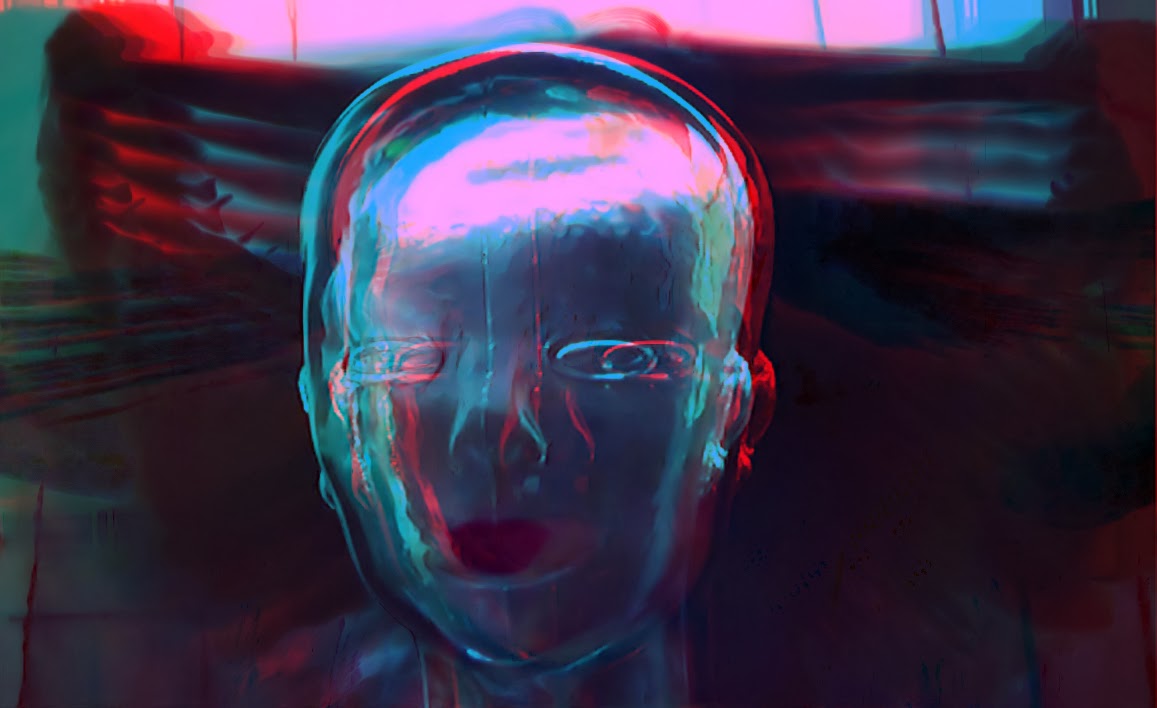
Kurchar 3-D starring Brenda Contreras

After some set back I finally got to shooting the much needed pixie scene for the 3-D Kuchar film I'm working on.  I was supposed to shoot with someone else who ended up having scheduling issues.

So, instead I shot with the young and talented Brenda Contreras - filmmaker, curator and Angelino living in NYC.  She was visiting the Bay Area last week and we got to talking about the project.  I mentioned how I needed a performer and I wanted to keep the project in the same style as Mike Kuchar's other films - namely using non-actors to perform and often the performers are filmmakers or artists and so his films end up being an eclectic mix of cameos.

Brenda agreed and she made her way out to my place in Oakland and we spent a couple hours shooting on a green screen.  She was very accommodating allowing me to spray her with sparkle spray and stand in the sun for a few hours.

The picture above is a screen shot with some very primitive and basic photoshop work to give you an idea of what it will look like in the end.  It's still far from the final version.

During shooting the encouraging line was "you look just like Bjork!"

More to come soon.

Monday, December 30, 2013

Kuchar in 3-D

So, a couple years ago the Hollywood King of 3-D, Ray Zone, gave the Godfather of Queer Cinema, Mike Kuchar, a 3-D camera. Let me take a little step back. Ray Zone was probably the single biggest advocate for Stereoscopic 3-D imaging that could ever be compiled in a living being. He was very positive, loveable and really interested in everything you had to say.

I was opening my semi-secret gallery and screening space in the dark corner of Skid Row in LA. My very first film screening was a selection of Mike Kuchar's videos. I flew him to LA and set him up in my apartment/gallery. It was his first time to LA in almost 3 decades. It was a great show with a full house including Mr. Ray Zone. I believe it was the first time Ray had seen Mike's work, but he knew of Mike's reputation. Ray being the generous person that he is and also always trying to spread the gospel of 3D gave Mike the new Fuji W3 Finepix 3D camera telling Mike that he "just wanted to see what he would do with it".

Mike graciously accepted the camera and when he returned to his home, San Francisco, he began making plans to start on a new project. Mike shot a few scenes with some of his regular stars, but at a certain point he simply had to abandon the project. You must understand, Mike is a very traditional filmmaker. Sometime in the 80's he transitioned from film to video and later still he transitioned to digital video tape. All of these processes are radically different and each transition took many years for him to master. Now, in his 70's, he seems reluctant to make the transition to digital video files (SD card) based footage. This is due mostly to the fact that he has no computer and no way of editing the footage.

The camera sat on the shelf with the footage for months. It sat as Mike witnessed his brother, George, fight his battle with cancer and lose. It sat for another year when Ray unexpectedly suffered a heart attack and left us with endless questions.

Eventually, Mike decided to give me the camera. He knew I worked in 3D and lucky for us all the footage that Mike shot was still on the card in the camera.

I started working on the footage, but quickly realized that even though the W3 camera is revolutionary in putting 3D easily into the hands of anyone it still has many bugs. With this camera there is a problem with the alignment of the two images and for 3D that is an enormous problem. It's basically the difference between seeing 3-D and giving everyone a headache. So, I spend much time fixing the footage to prepare it for editing.

Now I am finally at the stage of editing. It's still going to take more time, but for now I have a few images for you to see - to be viewed in anaglyph (red-blue) glasses.  Not perfect, but getting there.


Saturday, January 19, 2013

Single-8 film: a missed lover

A little history:
Single-8 film, one of the more rarely used stocks.  This was Fuji's version of Super 8.  So, to explain this a little, Kodak originally created S8 to be extremely easy to shoot for home movie purposes.  It came in a cartridge so there was no threading at all.  It was just like sticking a cassette into a tape deck.  They, of course, patented this cartridge so that no other company could manufacture the stock and therefore most camera companies made Super 8 cameras.
Fuji decided to make their own version of the cartridge and did so in such a way that you could do one or two of the functions that was impossible with the Kodak cartridge - namely run the film in reverse (this might seem simple and unnecessary, but can come in handy for camera tricks).  This warranted the need for Sinlge-8 cameras, which were only manufactured by Fuji.  This stock and cameras were really only popular in Japan.

As a film stock, Single-8 is identical to Super 8 except for the cartridge (and Fuji film has a polyester base where Kodak mostly has an acetate base).  So, once your film was processed and returned you could still use your Super 8 projector to run Single-8 film.

Last year Fuji discontinued the final stock of Single-8.  This was a time when I was struggling financially and therefore I could not purchase any film, sad to say.

Single-8 and me:
A couple years ago I met a generous and elegant filmmaker named Sky David through my involvement with the iotaCenter.  He told me he had quite a bit of film equipment that he wanted to get rid of and that included Sinlge-8 camera. So he inquired if I might know anyone who would want it.  I jumped at the opportunity and exclaimed that I would.  He quickly mailed me this extremely complex Fujica ZC1000.

But he also included 4 rolls of film, which I was not expecting.  They all referenced an expiration date of some time in the early 80's, which only added to my excitement receiving this treasure in the mail.  This was the first time in about 5 years or more that I had some film to shoot.  I still had my 16mm bolex (with light leaks) and a Super-8 camera that the motor was wearing down and only running intermittently.

So, I'd just been given my best working camera and film.  It took me some time, but I'd decided to finally shoot the rolls of film.  Some on my roof top (with an amazing skyline of downtown LA) and some in other places.  But then I was in a predicament.  I didn't know where I could process the rolls.

I'd contacted Retro8.com in Japan, but they'd quoted me something to the effect of $50/roll for processing.  So, $200.  No thanks. I looked into Rocky Mountain Film Labs, which normally is extremely helpful, but not in this case.  I searched and searched online for any processing information, but to no avail.  So, I just hung on to the rolls for almost two years - exposed, but unprocessed.

Eventually, I'd decided, for some reason, that I was going to try hand processing using the E-6 technique.  I got a small kit from Freestyle Photography in Hollywood and I did a snip test including these rolls and some other 16mm film I had in my arsenal.

To my surprise the only rolls that worked were the Fuji Single-8 film.


This ended up being some of the best stock I'd ever shot.  Specifically the Fujichrome R25N, which has a greenish tint to the stock.  Of course, you can see there are color shifts due to the old date of the stock and there seems to be some mold or something that animates about half way through, but it looks amazing!  I was in love....

Kodak usually ends up being more of an orange colored stock, but the R25N being green was really breath taking.  There was only one roll of RT200 and that ended up being kind of blue as well.  So, I was not as keen to that stock, but it was still fun to shoot.


The breakup:
From this experience it renewed my interest and desire to shoot some more film and as the Fuji camera was my only working camera I'd decided to get some more Single-8.  The only place I can still find some Fuji film and specially in the Single-8 cartridge is from Retro8.com based in Tokyo.

In November I decided to use this film for my current project with my residency at the Echo Park Film Center.  However in dealing with Retro8 over the past 3 months I've so many delays and frustrating occurrences with them that I can not use Single-8 film and finish the project on time.

Originally, I'd decided to get one of their variety packs.  I wanted to test each of the stocks that they had and then pick one to make my project with.  This consisted of the R25N, Cinevia 50, Cinevia 100 and Retro-X (b/w) all reversal stocks and some of them were custom made.

In particular the Cinevia 100, which I tried shooting and shooting and shooting, but something was wrong.  Eventually, I decided to test the stock to see if it was moving in the camera at all and I found out that the take-up side of the spool was not pulling the film through.

So, I had to send it back to Retro8 to fix.  Which took a few unanswered emails to figure out what to do and get it done (I even included a nice note in returning it and a Kodachrome pin I'd gotten from EPFC as a nice Japanese style gift, but that didn't seem to help).

This was back in early December and now 6 weeks later I have received nothing.  I was told that the cartridge was shipped before Christmas and I keep emailing Retro8 for updates, but they are always reluctant to respond and demanding that they shipped it off with no interest in trying to make this ordeal any better.

So, again, I have 3 rolls of exposed, but unprocessed film.  I paid $250 for these four rolls and that included processing.  So, I still have to go through the same BS when I have them processed.

Unfortunately, I payed them via paypal, which only gives you 45 days to dispute a charge.

And now it's too late to use the film for my project, which makes me very sad.  At this point I don't think I'll want to use Single-8 film again.  It's sad cause the moment I fell in love with it was also the moment that it became out of reach.  It's like a one-night-stand.  Leaves you happy, but wanting more and now they won't return my phone calls.

The only thing I'm trying to figure out is if I can recycle the old cartridges from the films I hand-processed.  That way I can use any film (and I have a roll of Kodachrome in a S8 cartridge - unexposed) and insert it into the Single-8 cartridge.  It seems doable, but I can't figure out how to pry the cartridge open without damaging it.  Then I'd also have to correctly put new film into it....in complete darkness.

Seems tricky, but I still want to try it.

Thursday, January 3, 2013

Artist in Residence

In February I begin my AIR (Artist in Residence) at the EPFC (Echo Park Film Center).  I have a lot of things I'm preparing for this right now.  So check back for updates.

For now keep in mind I will have a screening with a few films including a brand new one I will be completing for this residency, which will take place on Thursday Feb 28th.

I will also be hosting a workshop on film projection and expanded cinema on February 23rd starting around noon.  As a projectionist for over 10 years and the current head projectionist at RedCat you might learn a thing or two ;)  I'll also be discussing some of my secrets of when I do live visual or expanded cinema performances.

Wednesday, June 20, 2012

Obituary for the LA City Market

For those who don't know. The most amazing complexes in the entire city of LA is the City Market of Los Angeles. This is the long giant two square block complex of loading docks that appears to be at least 80 years of age. Surrounded by San Pedro, 9th, 11th and San Julian streets the complex is one of the most negelected, over used and amazing constructs. More then anything this building represents the beauty of collective construction, neglect and pieced together necessity. More specifically the entire place was originally used for loading and unloading of goods. Huge trucks would move in and out during the peak of it's life time.  There were a few major accidents and thousands of minor accidents most were left as is and only a few times did the owners decide to try fix any damage done.

It was originally build to house businesses and make it easy for trucks, vans and other vehicles move in and out.  Chances are there were at least a few dozen deaths and maybe even one or two murders within the life of the premises.  It also appears that there there a few different parts of the building that once had extensions to it.  Therefore, there are some walls and doors that were once interior, but for some reason or other a part of the building needed to come down and now the wall or door was exposed to the outside world when it was not intended to.
The image to the right is a perfect example of a walk-in fridge door that was no longer in use and mix of laziness necessity to keep the door permanently closed someone decided to use a 2x4 to block it off and the need to mask the wall as much as possible by painting it the light camouflage green in order to conceal the door just enough so that people won't casually notice.  In a way this turns into that "truth is stranger than fiction" or I would call it "accident is more beautiful than art".  What artists in their right mind would even think of creating a door and even creating a door in such a fashion?  And yet I have never seen anything so beautiful.

So, now in it's latter years with an inch thick layer or rust and it's 10th coat of paint the owners have decided to tear it down.  It's age has reached the eclipsing point where the asphalt that was crudely added in the 60's or 70's has worn away enough for the elegant tiled brick ground to peak through and just a tiny amount of the old railway has shown through as well.  Now the complex if half gone.  The amazing Art Deco sign has turned in to a vulgar Billboard and the cranes have already ripped apart the entire north corridor of the complex.

In speaking with one of the owners I mentioned that this is one of my favorite places in LA he replied "Ya, but it's unsafe."  And it was the most obvious explanation that made me realize and masochism of my aesthetic appreciation.  Reason why I love this place is 1) because if has an old classic look to it (in a strange way it's like being in Italy - but this is a totally different time period) and 2) it's totally neglected.  There were hundreds of thousands of decisions that lead to people decided to clean something up either in a half-assed fashion or deciding not to fix something at all!  AND this is the very reason why it must be destroyed.  There is simply no way for this space to be usable and safe.  It's like an old dog that you love, but it's so old that it's body hurts by just existing.  You can't be so selfish to keep it around when it's in so much pain.  It must be euthanized.  Still, I'll always wish I had more time with it.

When I first saw that space I knew I wanted to have a crazy huge installation of art, video projections, DJ's - just one crazy huge festival of art and music. Certainly, the best time to visit is night. Unfortunately, that will have to be left to my dreams.

Good-bye, old friend.

Thursday, June 14, 2012

Documentation of the disappearance of the most beautiful structure in LA

Can you spot what is missing from the right side that's in the left?
This is probably my favorite spot in the whole world. I've been shooting here for quite a while and one day I came along and noticed that the most beautiful piece of this area is now gone.

Friday, June 8, 2012

Broadway Bridge example

Here is a fairly simple example I did with some footage I shot the other night riding over the Broadway bridge.  I used After Effects stabilizer because the footage from riding my bike is extremely erratic.  I'm also using temp music from Languis.  I will want to work with them once this project gets more legs (and hopefully funding so I can pay them), but I'll also want to work with other ambient music artists as well.  But I think it works really well.  There's just a couple parts where the AE stabilizer just completely fails that I'd like to fix up.

More to come.


Saturday, April 28, 2012

Dandelion design

without shadows
Just finished with modeling, texturing and "furring" my latest model of a dandelion.  This will contain the same colors and shapes as the other design - cyan, violate, white and orange as well as cubes, spheres and cones.

However, I am having some issues that I need to work out.  I like the shadows I get on the ground, but you can see there are some shadows that the fur picks up that looks bad.  I don't know how to separate that out.

"fur" with shadows
There's no way to "unlink" lights to fur like you can other objects and you're supposed to be able to separate that out in rendering under the fur and/or light attributes, but I don't see it (I think that's a new addition and I'm using Maya 2009...cause I'm poor).

It looks like I'm going to have to work this out in compositing.  Last time I did shadows separate I had a hard time working it out.  So, something new to learn.

Also, the rendering times are pretty extreme.  The last model had about 30 seconds of rendering time per frame (that was full HD).  These renders were just for 640x480 (less then 1/4 of HD) and fur without shadows took 1 minute 13 seconds and 2 minutes 40 with fur.  Separating them out in comp will fix that, but I still need to figure out how to make it all shorter.

cyan "petals" with violate "fur" - rejected idea
Another thing I was trying was using different colors on the fur then what is on the geometry.  It looks kind of interesting, but I don't think it looks quite right.

Well, there's still a long way to go.  I just have two models rigged and ready for animation.  By the end I'm a little worried about rendering times and more worried about having too much geometry for Maya to even run without crashing constantly.

On another note, I just have to add how frustrating it is that what I am doing is extremely complex and for "experimental cinema" it's quite advanced, but even at this stage in the animation and VFX world this is really low tech.  Not to mention how in the experimental cinema world they don't care too much for animation of this kind.

Saturday, April 21, 2012

Garden test #2

So, I spent a whole bunch of time writing out a complex series of expressions.  For those who don't animate digitally that's basically kind of like programming - writing mathematical equations that set relationships between different things.
Basically what I wanted was to have the parts of the flowers grow to their full form, but I didn't want to animate each cube or sphere or anything.  So, I made a simple circle (that is invisible) so that when it's at 0 degrees all the objects are at the same place and I rotate the circle to 180 degrees all the cubes and etc are in their final place.
This took about three full days to write the expressions, but it took only an hour or so to animate.  You can see the picture here is basically what I had to write, but keep in mind this is only 1/4 of the entire thing.  I couldn't get it all in one image cause it's too long.

But it turned out really great looking in the animation.  Also, the nice thing is one series of expressions like this creates 12 flowers because changing color or shape doesn't require any different expression.  However I still have 7 more series of expressions to go through and that's just for the flowers.  I haven't even started planning out the bushes, trees and waterfalls.  I have a feeling that this is going to be an extremely heavy scene.  Having too many objects can cause my computer to chug along slowly cause I don't have the top of the line computers nor a render farm like huge studios do.

In any case, here it is.

Wednesday, April 11, 2012

The Digital Dilemma of Experimental Cinema


And so, now we find ourselves at a crossroads.  The few of us that have wondered our brains into the forest of Experimental Cinema have found a wall.  The box that we are outside of and originally left behind has become stifling.  The new world that we have imagined has a limitation.  A roadblock upon aesthetics has barred many from being open-minded in their open-mindedness.  Technology has forced us to take sides in a foolish battle.  Experimental Cinema has become the last battleground for celluloid film.
There has been much speculation over the decades upon the end of film in which video will succeed the throne of the field.  It has become an endless dialogue how analog film will end.  Because of this and because video shares some fundamental qualities that are different from film many filmmakers, curators and fans of Experimental Cinema (and all cinema) have rejected video.  It is a radical change to put upon a system that is over 100 years old.  So many have devoted their lives in order to understand it perfectly and now it is completely deconstructed by a different medium.  A medium!  And nothing more.
Virtually all other areas of cinema have accepted this new form in which to use the same techniques.  Large production narrative, television and advertisement (aka Hollywood) have been behind funding this development.  It has made previously difficult processes become significantly easier – and at the same time they had added more expectations and workload to the productions.  Documentary, world and “independent” cinema use it as a means to cut the budget and shift funding.  Home movies became significantly less hassle with equipment easier to understand.
Digital has become the standard and it is almost because of this that the culture of Experimental Cinema is unwilling to unclench its fist from the 16mm reel.  The question then becomes – is it rigger mortise? 
Will this last stand for celluloid cinema kill the world of Experimental Cinema?  But I need to stop for a moment.  Surely there is a whole chorus of voices now who are angry because I am saying that digital is better then analog.  Do not be mistaken, dear friend!  My love for celluloid will never be extinguished!  However, you cannot deny the strong generalized rejection of digital “filmmaking” in the Experimental Cinema culture.  It is very similar to a certain artist by the name of R. Mutt who in the first half of the 20th Centruy caused a tornado of kerfuffle when many declared his found art piece, “The Fountain,” not to be art.
Rejection to such an unnecessary extent as this is what I like to call “The Aesthetics of Rejection.”  It comes when an individual rejects a certain artwork or medium as “not being art”.  Certainly, this can be applied to more then just the world of art and cinema.  Indeed, a colleague of mine, a very intelligent individual who had strong passion for Socialism and the films of Godard and Eisenstein actually told me once that video games are not art.  I was appalled.  However, most people have learned much since the days of R. Mutt, however.  People usually do not reject something outright as “not art”.  Most use a disgusting categorization in which the culture of Experimental Cinema was invented by breaking – “good” or “bad” (also known as “high” or “low” art).
Anyone who is familiar with Experimental Cinema is familiar with the standpoint that video/digital is “not good” or “low quality” or some how displeasing.  I implore you not to follow in this path.  It is segregation!  One is not better then the other.  They are merely two different tools and each possesses different qualities.  I can only imagine the day when a pupil came to his teacher with a sponge instead of a brush in which to paint with and the lashing the pupil received for such an offence.
There is also the other even more revolting argument.  No, assumption!  The assumption that working in film is significantly more difficult then working digitally.  This somehow gives merit or validation to considering one form of cinema “good” and the other “bad”.  This is often an argument made by critics who have never used a movie camera in their lives.  I assert once again that the tools are merely different and some things are easier in film and others digital.  Anyone who has spent nights rendering 1000 frames in Autodesk Maya with 4 layers per frame each at 30 seconds rendering time per layer only to realize that you had one thing slightly off and it ruined your whole scene knows what I am talking about.  Anyone who has used Mental Ray would never say that digital is easier then film.  Even now with the dieing businesses of film development laboratories, it can be faster to send a roll of film to be processed and get it returned to you than to have a scene rendered from a CGI animation package.
Therefore, it is absolutely preposterous to make any judgment call about which is better or which is worse.  The only thing that the aesthetics of rejection reveal is what forms of art people don’t like.  A story can be poorly written.  An image can be badly composed, but a medium cannot in its entirety be bad.  If you do not like digital filmmaking then just state that.  That is at least a respectable stance.  I do not particularly care for Heavy Metal.  By no means would I consider Heavy Metal not to be music.  How absurd; I wouldn’t even consider it to be bad.  I just don’t like it.  And even within that I subject myself to live performances of such music because I enjoy music; I want to be persuaded to like Heavy Metal; I enjoy the atmosphere of a music event; it opens my mind as to the possibilities of our world.  (In fact, the films that I learn the most from are the films that I do not like - they teach me what I never want to do in my work.)
Yet, you can see everywhere in our current culture of Experimental Cinema that film is virtually the only accepted method of making our form of art.  Young artists who come to fruition are only accepted if they work in film.  Certainly, those who only work in film and are successful are likely to be very good filmmakers, but there are an equal number of filmmakers artists who work digitally whose pieces you might significantly enjoy, but since the Experimental Cinema world looks down upon digital works you will never be exposed to them.  Most often these individuals turn to a different world where they are more accepted – "interdisciplinary art", "multimedia art", "new media", etc.
“But there are many filmmakers who work in digital video that we will always watch.”
Who? Jonas Mekas? Su Fredrich? Ken Jacobs? The Kuchar Brothers?  This is only because they were already accepted as filmmakers before they picked up a video camera.  They were already infallible and therefore did not receive the wrath of the aesthetics of rejection.
How many who consider themselves to be studious and wellsprings of knowledge of Experimental Filmmakers even know the names Miwa Matreyek or Dr. Strangeloop (David Wexler)?  Certainly, there will be some.  However, both artists have become world-renowned and both attribute more influence to filmmakers who are generally accepted under the umbrella of “Experimental Cinema” then other artists, but both are rarely discussed in our culture.  Why?
If we let these authoritative rules hinder us our field will become stagnant and we will let it die.  Experimental Cinema will end with the final filmmaker who became known with their films.  By no means am I making a case for filmmakers to stop working with film.  I hope celluloid sees many more years, but critics and fans who really and truly love “Experimental Cinema” must accept digital if it is to continue.  For if we are actually the expansive thinkers who can see meaning amongst the abstracted shadows on the walls of the cave then we must have a perception that is expansive enough to accept digital.  Let no boundaries stop us!  Let us re-radicalize “Experimental Cinema”!

Sunday, April 8, 2012

Implosion 3: Designs and things

I'm starting to do designs for the new piece.  Basically the way the film will work is a simple camera move through a scene as a garden grows out of the ground.  The camera will move through a maze and the garden will grow.  Every so often it will raise levels to taller and taller foliage.  I have planned out 5 levels all with different designs -
Level 1 - short flowers
sections and timing
Level 2 - taller flowers
Level 3 - bushes and short foliage
Level 4 - trees
Level 5 - waterfalls

Right now I've only designed the flowers.  I will have four designs for both sections (eight in all).  Each design will have four colors - violate, cyan, white and possibly yellow (tentative).  And each design will have three shape bases - cones, spheres and cubes.  This makes 12 types of flowers for each design and so 48 for each level; 96 flowers in all.  As you can see in the map, the outer two sections are levels 1&2 and they are the largest so it will take a very long time to model and rig, but it will be worth it. If I only used four flowers that would get old fast.

I have some timing there as well.  Within level 1 you can see an "x" in the bottom slight left.  I have roughly timed that to be 6 seconds.  This could easily get longer, but at least for now I think it's a good start.  I was mostly working backward.  I want the film to be at least 3 minutes in length.  There's roughly 30 sections that are the size of "x" in the whole map, which makes for 6 seconds for each "x".

camera moves and levels
As you can see here in this image the camera will start in the bottom and follow the path of the 1st level, then rise as it reaches the 2nd level, the same with the 3rd level, etc.  All along the way the flowers and foliage will rise from the ground as the camera passes. And at the end I'll probably add some spin or something.  We'll see. I have a feeling I'll be motivated by Ale's music and play off of that at that point.


Here are my two sets of sketches for the flowers and the respective names I'm using.  Most of these are wrong or variations of real flowers, but I'm more using them for naming purposes in my scenes rather then making for accuracy.

I modeled my first flower.  It's a white, cube, "sunflower".  And I used the near final render settings (lighting and texturing) that I like with an HDR for somewhat natural lighting - really it doesn't look "real" I just like some of the HDR's that I've made cause they give a nice soft look where no part of my scene feels like the color stays exactly the same across a certain part of the image.


Experimental Cinema is a Radicalizer


At what point in a career does one establish a rationale for experimental cinema?  How long after a medium’s formation is it still acceptable to describe its purpose?
There is no reason to limit a date of publication for logic.  The difficulty is that there is already much history of written text upon the subject and even upon this very topic.  The history of experimental cinema is equal in length to the history of cinema and now with well over 100 years of cinema there is also 100 years of cinema rhetoric.
However, just like everything it is subject to constant change, constant analysis and constant invention.  The most important concept to retain throughout this spilling out of ideas is, at the very least, an attempt to avoid reinventing the wheel.  I will start by stating that for as long as possible I will stick to the singular term “experimental cinema.”  Only so that I do not digress into the endless cycle of terminology semantics and nuances of “experimental,” “abstract,” “avant-garde.”  But rest assured I mean to use the term “experimental cinema” to encompass all these terms and more.  And, specifically for the purposes of this article, the limitations of the term are not defined by the writer, but by the reader and movie-goer.
Experimental cinema is a radicalizer.  By its very nature and function it has the potential to change people very extremely – to radicalize them.  How can this be?  How can such a passive recreation of cinema instigate such a shock?  Let’s set the scene, shall we.
It is an old scene. In fact, it is older then some societies, religions, cultures.  It is the cave analogy.  Whether Plato invented it or if it was indeed created by some figure named Socrates makes little difference now, but is now immortalized in the classic text The Republic.  It is a stage described many times again and again.  For our purposes it is quite apt.  It is really a very good description of what a cinema must have been like in the 3rd Century BCE.  We start with a cave and in this cave we have individuals, let’s call them slaves because in Socrates mind they pretty much were.  These slaves are locked in a seated position and forced to stare at a wall.  They have restraints so that they are unable to move their heads.  Upon the wall are shadow and these shadows are created form a glowing fire, which is behind the slaves.  And in between the slaves and the fire are people, or projectionists - if you will, who pull out stocks of shapes – a horse, trees, cows, sheep, people, hills, buildings.  These shapes are brought up to where their shadow is brought into the filed of vision of the slaves and then removed, replaced by another shape, which is thusly removed and the cycle goes on.
The slaves are made to believe that this is the full scope and reality of the world.  Socrates invents this mythical world to describe the state of his world saying that the people who are marveled and praised are those who are like a slave that has a great skill of predicting correctly as to which shadow that will be the next to appear before it comes into view.  In his mind, a philosopher is damned with a punishment of knowledge because they are like a slave who is released and able to leave the cave and able to see the world as it truly is.  A freed slave who then returns to the cave describing to the other slaves what this real world is like and the fiction of their existence and their foolish guessing game is ridiculed as being delusional and crazy.  And Socrates continues to describe a world ruled by philosopher kings and the society they will create in a perfect world, which goes quite beyond our immediate needs at the current moment in relation to Experimental Cinema.
Let us take this scene and reverse it.  Not so much in it’s power structure nor it’s scenario, but within it’s linear structure.  We start with a free people. They wonder about this world their entire lives seeing the world as it is.  Over time they take it for granted, but still continue living.  At one point one individual enters a cave lead in by strange discolorations on the rocks that seem to have a shape or meaning.  They are lead further and further back until they find huge shadows upon the wall and a comfortable seat, which makes for easy viewing of these shadows.  At first the shadow catches their eye because it is moving, but they cannot make sense of it.  After some time they begin to realize that the shapes are representations.  It takes quite a bit of pondering and conjuring, but they eventually see the shapes as signifying of objects that they know from outside the cave.  Symbols, representations or abstracts that take some time to explore with one’s imagination in order to make the connection to the referential object.  These shadows deviate from their originals.  They are two-dimensional, without color, different in size, alternate design and they also bare some other characteristics that function in order to resemble the original, but through simplification.  For example, there is a figure, which is a circle with lines protruding directly out from it to represent the sun.  The original sun has no lines protruding from it, but the lines work as an abstract representation of rays of light extruding from the sun.
The forms of images begin as fairly representational.  Their shape is proportionally the same as the originals with only slight mental adjustments and explorations into personal imagination does the individual make sense of the shadows.  The shadows continue and the individual starts to realize there is a correlation between the images.  It is telling a story.  This story starts out realistic and after some time delves into an imaginary world where real objects are converted yet again so that they are harder to distinguish from their original.  Still after some pondering and analysis of these new shadows does the individual continue to distinguish the symbolic meaning of the shadows.  The story further continues into alterations and more alterations of reality until the objects are completely abstract.  It is at this that the individual is baffled.  S/he takes labors mentally over these new and completely foreign objects.  They leave the cave and are dizzy with confusion then return again to attempt to make sense of the objects once again.  Finally it hits him/her that these objects are solitary – they symbolize no referential object.  There is no name as to call each of these objects.  They are to be accepted purely for what they are and nothing more.
At this we have come to the radicalizing moment.  If the individual accepts this then they become radicalized.

Now the individual returns to the external world with his/her friends and colleagues.  S/he describes for them of this marvelous other world with new and different objects.  They begin to understand other objects and concepts of their former world as also possessing the ability to have alternative expressions.  First it starts simple.  "How is this plate both a function for eating and an abstract sculpture at the same time?  What are other ways we can make a plate that is radically different but still carry a function?"  Then it goes beyond simple everyday items.  "If I squint while looking at this tree it becomes a completely abstract shape and has beauty to it.  At what point is the tree no longer a tree?  Is it determined by how I look at it?"  Eventually over time they explore larger world concepts of sociological, political, cultural and philosophical navigations.  "What other ways can government exist that they might be abstracted, but still carry a purpose?"
Their friends and colleagues will think they are delusional or hallucinating, but individual assures them that what they have witnessed is true.  “So, what you have seen is real?” one might say. 
“Well, yes.  And no.” s/he would answer. 
“And these different and other worldly objects, they are real?”
“Both yes and somehow no.”
“Well, how can this one thing exist and not exist?  And this other world with other governments and other countries and other economies, how can they exist if your impetus carries such a flawed genesis?”
“It might be possible that if you also see this then you will understand this alternative world.”
So, the individual takes his/her colleague to the cave.  However, in this case the colleague does not accept what they see when an abstract appears in their field of view.
“Do you not see this strange object that represents only an abstract form?”
“All I see is a shadow and nothing more.”
“But the shadow has a representation of a large meaning beyond what you can see.”
“The shadow’s only meaning is that it is a shadow.  You’re ideas are flawed from the start.  I will bother no more with this.”
And so we are left to ourselves, but now the seed is born.  As we’ve accepted experimental cinema we must accept and even instigate experimental life-styles, experimental habits, experimental logic.  A notch has turned in our brain.  What was previously not possible has become possible.  What was previously out of our angle of view we now see because our view has become so wide that the horizon has disappeared.  Reality holds a myriad of possibilities.  Realization is brought upon because of the field we engulf ourselves in.

Friday, March 30, 2012

Garden music (early itteration)

So, I just talked with Ale and he loves the test video I gave him.  He also has a song he's working on that he thinks this would be perfect for.  I think it sounds great and even gave me a few ideas.

Implosion of Light: The Garden (start)

Well, I still have one more song by Ale (aka Languis) to create some visuals to, but after a couple of these animations where the visuals were strongly synchronized to the music I decided that I wanted to go in a little different direction.

I'm not sure where it came from, but I started to have visions of a growing garden made of cubes, spheres and cones.  I'm in the process of designing and planning, but I made a quick and simple style of what I'm thinking.


The design, animation and everything is extremely simple, but this was just a test.  I was having trouble in the rigging process.  Basically I didn't want to have to animate each little cube on it's own and I wanted to have something else simple driving the cubes into growing.  That way when I actually animate it's quite simple even though it looks complex.  It's still time consuming, but if I was going to animate every single cube individually I probably would completely nix the idea.

I've sent an email to Ale to see what he thinks of letting me take the lead on this and I'm waiting to hear from him.  I'm sure he'll like it, but he's also a super busy guy.  I asked him if he wanted to do his own version of the first prototype piece (the one I animated to the music by Eric Satie) and he thought it was a great idea, but work and kids have gotten his hands full.  Still once he gets to it I think it'll be amazing!

I'll post designs soon!

Implosion of Light 1 & II

After I returned from Italy I met with Alejandro Cohen of Languis (the sonic component of Parallel) because I enjoyed working with his music and I wanted to continue the collaboration.  He loved the idea and quickly came up with three sonic pieces, which I slowly slowly animated to.

I am very grateful to him for his patience.  It showed around a few times at the Punto y Raya Film Festival in Madrid, Dublab's labrat Matinee here in LA and a couple other places.

You can see the first one below, but the second one just completed in March of this year and will be making the rounds to festivals.  If you would like to see it please ask for it!


UPDATE: Ale is going to post Implosion II on the Dublab blog. So, I might as well post it here too.

Implosion of Light 0

So, I've been working on this series for a couple years now.  I'm calling it "The Implosion of Light an Sound".  I thought of that title while I was on a minor shoomie trip a couple years ago and had a crazy vision of CG cube based pixelated images.

I had a residency in Florence Italy and was very moved by these mosaics there.  Particularly the one's in Revenna on the East Coast below Venice.  It contains some of the oldest and "most perfect" mosaics (according to some historians) and rightfully so.


I was particularly moved by the abstract ones and after some weeks of contemplation I decided that I wanted to take that idea and use my skills as an animator and a 3D artist to create a new type of mosaic.


At first I just wanted to make a simple animation using just cubes and animating to music (because I feel more free to be abstract, but audiences will accept it).  I knew I needed to start off with on my own cause it would be a little difficult to explain to someone without an actual example AND it was extremely important to get a "pipeline" (or workflow) working because it would be pretty intense and I wanted to make it as easy as possible.

I was also pretty passionate about making it, what I'm calling, a "Virtual Sculpture".  I started looking into holographic technology to see if I could create animated holograms.  At the moment that technology is not quite ready for complicated animation.  So, I decided to go with making phantograms.

A Phantogram is basically a hologram, but it can only be viewed from a specific angle.  It needs to be stereoscopic 3D (so usually wearing glasses) and it's a forced perspective image meaning you need to look at it at a 45 degree angle to see it in a proper form.  So, if you create a phantogram it appears that the image is popping out of the monitor, table or floor.

It took some time, but I finally organized a pipeline and then I spent the next two months or so animating and creating my "prototype".  And this is what I came up with.